
Parachuting Onto the Roof
Our thoughts on the SpaceX IPO
Between now and June 12th, you are going to hear one name on absolute repeat: SpaceX.
The company is slated to go public in what is being billed as a generation-defining market event. Because it has been locked away in private markets for two decades, investors are wondering how to finally get a piece of the action. The excitement is palpable, imaginations have been captured and the numbers being thrown around are enormous. Wall Street is valuing the company at $1.75 trillion to $2 trillion, which would mean that investors think SpaceX is more valuable than Meta.
Back in the day, an initial public offering (IPO) was a way for regular investors to buy into a promising company on the ground floor. Today, buying a mega-IPO is more like parachuting onto the roof. Because private funding pools are so large, it’s possible for exciting and innovative tech companies to stay private for years, allowing early institutional investors to capture the value created in the exponential growth phase. That means by the time the company goes public, those early stage investors and employees are looking at you as a source of "exit liquidity," which means they want to sell their highly valued shares to you so they can cash out.
So whether it’s SpaceX, Anthropic, OpenAI or any of the other mega-IPOs on slate for 2026, do not assume there is money to be made from buying on IPO day.
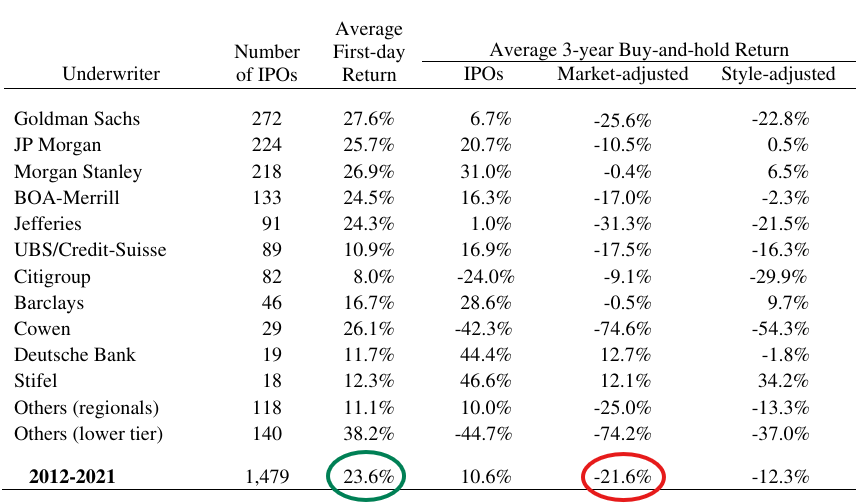
The data on IPOs tells a very consistent story. Dr. Jay R. Ritter, Director of the IPO Initiative, and Emeritus Professor at University of Florida Warrington College of Business, has compiled years of research on IPOs, and what the numbers show is that Wall Street banks are exceptional at manufacturing massive hype and drama, but they have a terrible track record of delivering actual long-term wins for investors.
Historically, these big listings tend to spike on day one, only to significantly underperform the broader market over the next three years. How significant is the lag? For companies that IPO’d from 2012-2021, their returns lagged behind the broader market by over 21 percentage points over the following three years:
If you are still feeling the itch to buy, history makes the case for being patient and waiting for a better price. Investors who bought Meta on its rocky first day of trading in May 2012 are up 1,472% today. But the patient investors who ignored the initial chaos and waited just six months for the valuation to cool off are up over 2,700%.
Waiting for a better price isn't very exciting advice, but waiting is integral to our entire investment philosophy. Whether you are buying stocks, corporate bonds, or Central Austin real estate, the price you pay dictates your ultimate return. Buying any asset without regard to a sane valuation is a game played at your own risk. Ask anyone who bought a house in Austin in May 2022 without an inspection.
The space industry has a long, innovative future ahead of it, but trading over the next few months promises to be choppy and completely unpredictable. Sitting on our hands and letting the institutional waterfall of stock clear out isn't nearly as exciting as riding a rocket to the moon, but in our opinion, it’s the best move for making money.
As always, our door is open if you want to chat through the numbers.