
The Market Keeps Hitting All-Time Highs. Now What?
One of the most difficult things we have to do as investors isn’t learning about the market; it’s managing the discomfort of the market’s volatility.
When the stock market is falling, it can fall fast. In that moment, fear feels rational. Every headline adds to the worry that this time is truly different. Cash feels safe, while stocks feel reckless. But when markets are hitting all-time highs? That can feel uncomfortable too.
You might think, "Shouldn't I wait for a pullback?"
It's an understandable instinct, but history tells a different story.
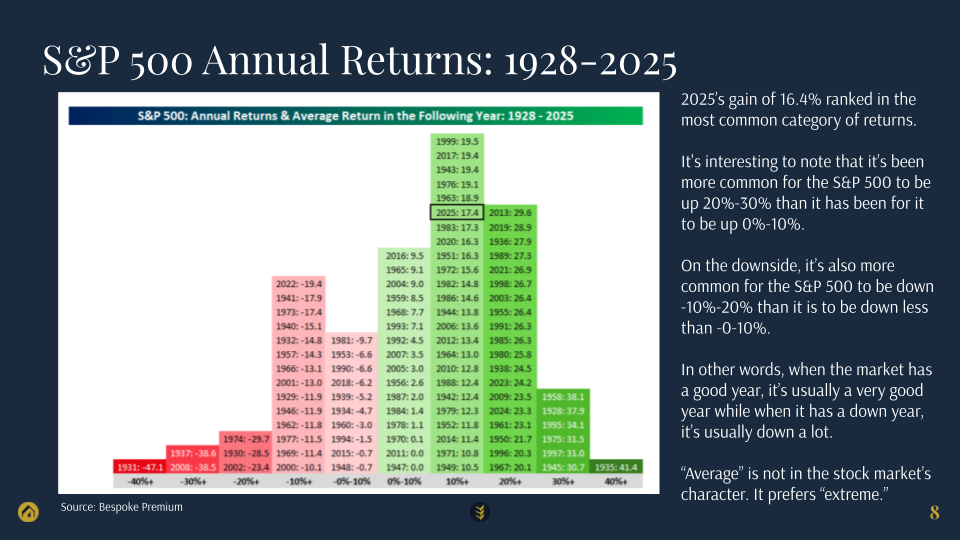
One of the charts I shared during our Mid-Year Market Review shows that the S&P 500 has finished far more calendar years with gains than with losses, dating back to 1928. Even more interestingly, strong years with 20 to 30% growth aren't unusual. They're actually more common than years of modestly positive (0 to 10%) growth.
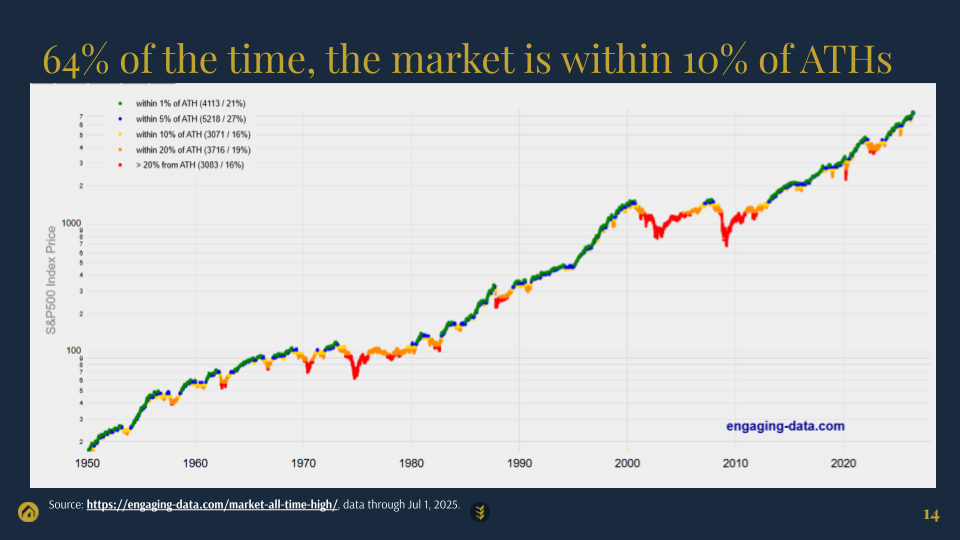
The second chart makes an even more surprising point: Since 1950, the S&P 500 has spent roughly 64% of its time within 10% of an all-time high. At first glance, that statistic feels unbelievable. Shouldn't all-time highs be...rare?
But historically, the market has grown at an annual clip of about 10% over time (before adjusting for inflation). If corporate earnings generally rise, businesses innovate, productivity improves, and the economy expands, all of which they are incentivized to do, then new highs aren't the exception. Instead, we can see them as the natural consequence of long-term growth.
In other words, the stock market spends most of its time doing something that freaks many investors out: making a run to new record highs and then actually hitting them.
Why does it feel so uncomfortable?
Because our brains don't experience gains and losses equally.
Behavioral finance has shown that losses carry much more emotional weight than gains. A market decline can dominate the news cycle for weeks or months, while years of steady growth gradually fade into the background. Let’s look back at all the green, blue, and yellow dots in the all-time highs chart. This is where the stock market has been within 10% of a new peak. At the time of writing this, it’s August 2026, and we’re at a green dot. Some folks would say, “I don’t want to buy here. Everything’s about to drop.”
Now imagine it’s March 2020 again, and the S&P 500 has dropped at terrifying speeds. Uncertainty has been the name of the game for months now, and no one knows how long things will continue to be this bad. Is now the time to buy?
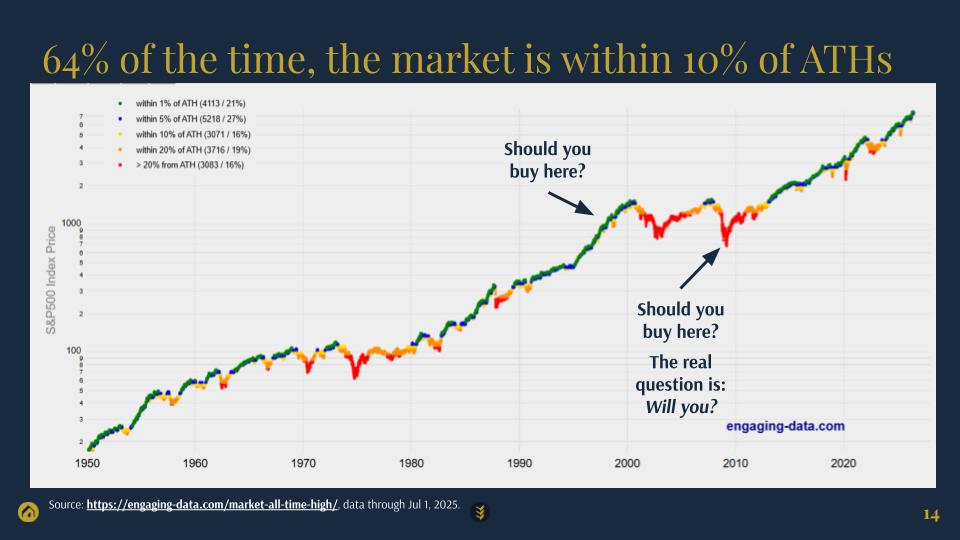
So whether the markets are up or down, we experience anxiety around our investing decisions. Behavioral economist and author of Thinking, Fast and Slow, David Kahneman, calls this loss aversion, our tendency to feel the pain of losses more intensely than the pleasure of equivalent gains.
That's one reason Warren Buffett's advice to “be fearful when others are greedy, and greedy when others are fearful” is easier said than done. Anxiety about the market, whether it’s falling or rising, can keep us waiting for a safer moment to participate. But as we’ve seen from the data, those moments are rare. All-time highs can feel risky, just as market declines can feel terrifying - and neither feeling tells us what the market will do next.
It's natural to feel nervous about investing money today and hoping it's worth more tomorrow. But investing is not about being sure. In fact, the volatility that characterizes the stock market is exactly the engine that drives the growth that we hope for. This is a feature, not a bug.
Now, what can we do about it?
Watching the markets day and night and wringing our hands isn’t an option. Or it technically is, but there’s life to be lived. Kiddos need to be dropped off at soccer practice. Loved ones need to be cared for. We need to go to work, see our friends, hit the gym, and enjoy our free time. So here are a couple of strategies for managing the volatility of the markets while staying sane. They are not mutually exclusive, and you can use a mix of all three.
Have a plan.
Crafting an action plan ahead of time and accounting for market uncertainty is one way to increase the likelihood of making good investing decisions. What are your entry and exit thresholds? (Maybe it has nothing to do with the market, and more to do with your unique financial situation at the time.) Determine what a good buying opportunity looks like ahead of time, and what would move you to sell, or hold.
Automate your investing.
Another strategy is to mostly ignore the market and dollar-cost average into both the highs and lows. Instead of trying to predict what the market will do next, you invest consistently over time. Some purchases will happen near market peaks, others during downturns. The idea is that you’ll capture the growth as it happens without having to make decisions at every turn.
Have an accountability partner.
It’s not easy to go it alone. That’s why the Austin Women’s Investing Group is so powerful. It’s why we at Black Barn Financial offer investment advising and financial planning to folks seeking to grow their money while navigating life’s transitions. Partnering with others who understand your personal reasons for investing and help you stick to your plan can be incredibly grounding during times of volatility.
Over the long run, the goal isn't buying at the perfect price; it's participation in the market's long-term growth. Understanding what lies behind our anxieties and loss aversion can help us make better decisions for our investment portfolios and the life they power.